
The best thing you can do to understand your child’s diagnosis is to learn all you can about endometriosis. It’s helpful for both you and your child to maintain an ongoing list of questions for your child’s GYN team. The doctors, nurses, and social workers will assist you and your child in understanding their diagnosis and the treatment options at all stages of their treatment.
What is endometriosis?
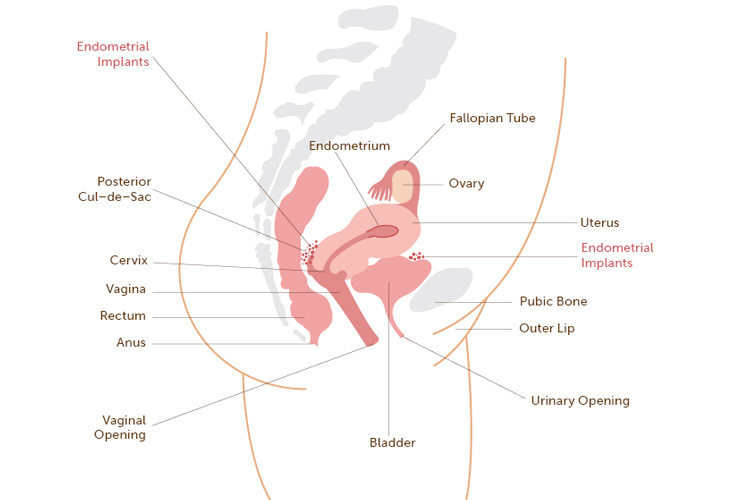
Endometriosis, pronounced, “end–o–me–tree–o–sis” can affect anyone born with female reproductive organs, regardless of their age. It is a condition that occurs when tissue similar to the inside lining of the uterus is found outside of its normal location. Endometrial implants can be found on the ovaries, fallopian tubes, and ligaments that support the uterus and tissue covering the bladder and rectum. The most common locations of endometrial implants in teens are in the cul–de–sac area (behind the uterus), and near the bladder.
What are the symptoms of endometriosis?
Endometriosis causes different symptoms in teens. Pelvic pain and/or severe period cramps are the most common symptoms. There can be pain before, during or after a period. The pain may occur at regular times in the menstrual cycle or it may occur at any time during the month. It is often referred to as “chronic” pelvic pain.
The location of the endometrial implants and the way in which the lesions affect the pelvic organs contribute to the symptoms people may have. Some people may have pain with exercise, sex, and/or after a pelvic exam, others do not. Although not as common, some people may have painful or frequent urination, diarrhea or constipation with pelvic pain. It’s important to remember that some people have a lot of endometriosis and have very little pain, while others may have a small amount of endometriosis and severe pain.
What causes endometriosis?
Although we know that some young people may be slightly more likely to develop endometriosis because female relatives have it, the fact is we do not know the cause of this disease.
The three most accepted theories are:
- Sampson’s Theory: This theory explains that the flow of menstrual blood gets “backed up” causing some of the blood to flow in a reverse direction. This process causes blood containing endometrial tissue to attach to surfaces outside of the uterus.
- Meyer’s Theory: This theory proposes that specific cells called “metaplastic cells” change into endometrial cells and are actually present at birth.
- Vascular Theory: This theory suggests that the endometrial tissue “travels” through the body via blood vessels. It then reaches various tissues, implants, and then grows, causing pain.
Important facts about endometriosis:
- Teens CAN suffer from symptoms of endometriosis. Medical studies have found this disease in teenagers and young children.
- Chronic pelvic pain is NOT normal. Most young people have no or mild to moderate menstrual cramps one or two days a month. If your child is absent from school because of pelvic pain or menstrual cramps, tell their GYN team.
- Endometriosis occurs among people born with female organs, regardless of their race.
- Endometriosis is NOT an STI (sexually transmitted infection).
- Getting pregnant does NOT cure this disease but may improve symptoms for some people. Some people with endometriosis who have had children continue to have pain.
- If your teen’s pain makes them feel at all disadvantaged compared to other people their age, this is NOT normal. Your child should not “normalize” their symptoms. If your child doesn’t feel like they are equally capable as other teens their age (because of pelvic pain), they should tell their gynecologist.
Our health guides are developed through a systematic, rigorous process to ensure accuracy, reliability, and trustworthiness. Written and reviewed by experienced healthcare clinicians from Boston Children's Hospital, a Harvard Medical School teaching hospital and consistently ranked as a top hospital by Newsweek and U.S. News & World Report, these guides combine clinical expertise, specialized knowledge, and evidence-based medicine. We also incorporate research and best practices from authoritative sources such as the CDC, NIH, PubMed, top medical journals, and UpToDate.com. Clinical specialists and subject matter experts review and edit each guide, reinforcing our commitment to high-quality, factual, scientifically accurate health information for young people.